Meeting Agenda & Minutes
The agenda and the minutes are the same document, so the actions never get lost.
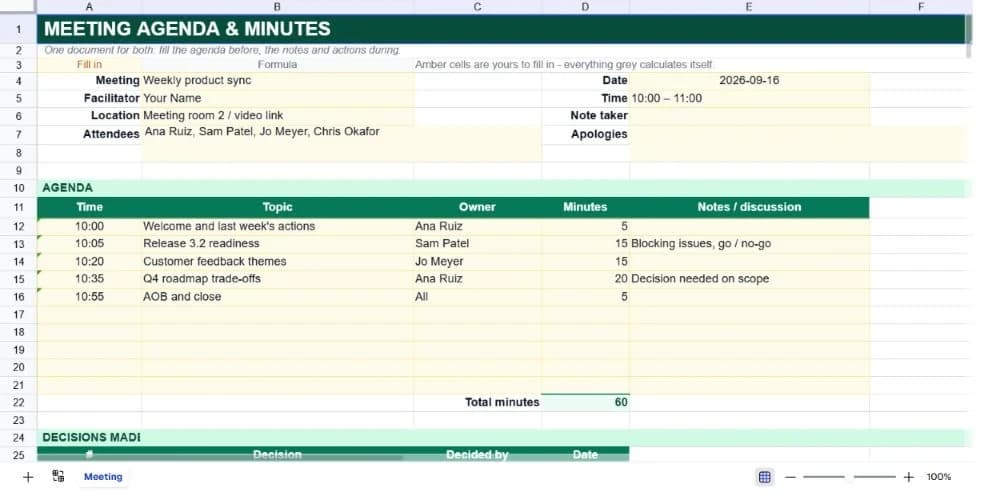
About the meeting agenda & minutes
Meeting notes usually live in a different place from the agenda, which is how action items end up buried in a document nobody reopens. This template keeps both in one sheet: you fill the agenda before the meeting, the notes and decisions during it, and the action items become a tracked list rather than a paragraph.
The agenda block carries a time, topic, owner and a minutes allocation, with the allocations totalling at the bottom. Seeing that your sixty-minute meeting has seventy-five minutes of content in it is the cheapest possible intervention against overrunning.
Below that sit two blocks that most agenda templates omit. A decisions log records what was actually decided and by whom, which is the thing people disagree about a fortnight later. An action items table gives each commitment an owner, a due date and a status, with a live count of how many remain open.
What’s in the template
Everything below is already built into the file. Open it and it’s there.
Meeting details block
Title, facilitator, location, date, time, note taker, attendees and apologies, with wrapping cells for long attendee lists.
Timed agenda with ten rows
Five worked items covering a realistic product sync, each with a time, topic, owner, minutes and a notes column filled in during the meeting.
Total minutes row
Sums the allocations so you can see the agenda's true length before you walk in.
Decisions log
Four numbered rows recording the decision, who made it and when: the record that settles later disagreements.
Action items table
Ten rows with action, owner, due date and status, seeded with three examples carrying real due dates.
Open actions counter
Counts rows that have an action written and a status other than Done, so the number is the follow-up list.
Who it’s for
Anyone running recurring team meetings
Duplicate it weekly. The previous week's open actions are the first agenda item, which closes the loop that most recurring meetings leave open.
Project managers and chairs
Timed agenda items with a running total make it obvious before the meeting whether the agenda actually fits the slot booked for it.
Boards and committees
The decisions log with a decided-by column is the minimum record most governance processes expect.
Client-facing teams
Send the completed sheet as the meeting summary. Decisions and actions are already separated out and attributed.
How to use the meeting agenda & minutes
- 1
Build the agenda in advance
Fill topics, owners and minute allocations before sending the invite. Check the total against the length of the meeting and cut accordingly.
- 2
Take notes in the agenda row
The notes column sits on the same row as the topic, so discussion stays attached to what it was about rather than becoming a wall of text.
- 3
Separate decisions from discussion
When something is settled, move it to the decisions log. That block is what people reread; the notes column is where the reasoning lives.
- 4
Assign every action before closing
An action without an owner and a date is a wish. The open-actions counter only counts rows that have text in them, so unassigned intentions don't inflate it.
The formulas that ship with it
Every one of these is already in the file. They’re listed so you can see how it works, and change it if you want to.
Total minutes
=SUM(D12:D21)Adds the agenda allocations, including the spare rows, so items you add are counted without editing the formula.
Open actions
=COUNTIFS(B33:B42,"<>",E33:E42,"<>Done")Counts rows that have an action written and a status other than Done. Empty rows are excluded by the first condition.
Tips for getting more out of it
- Put the previous meeting's open actions as agenda item one. It takes two minutes and it is the difference between a meeting series that compounds and one that repeats.
- Allocate minutes pessimistically. Most agendas are planned at about seventy percent of the time each item really takes.
- Record the decision, not the debate. 'Ship 3.2 on Friday, Sam to own the go/no-go' beats three paragraphs of what everyone thought.
- Duplicate the sheet before each meeting rather than overwriting, so the decisions log becomes a searchable history.
Ask questions about your data, generate formulas in plain English, and create charts instantly, all on top of the Meeting Agenda & Minutes.
Questions about this template
More business templates
Project Task Tracker
Owners, due dates and progress per task, plus a live count of what's overdue.
Use thisProfessional Invoice
Fifteen line items with per-line discounts. Subtotal, tax and balance due calculate themselves.
Use thisEmployee Directory & Org Chart
Contact details and reporting lines, with tenure and department headcount derived automatically.
Use thisSave hours
Skip the setup. Start from a ready-made structure.
Error-free
Pre-tested formulas that just work.
Professional
Designed for real-world use, ready to share.
Consistent
Maintain standards across every document.
Ready to use the Meeting Agenda & Minutes?
No setup, no learning curve, just results. Start free in seconds.
Pay as you go, no subscription required